
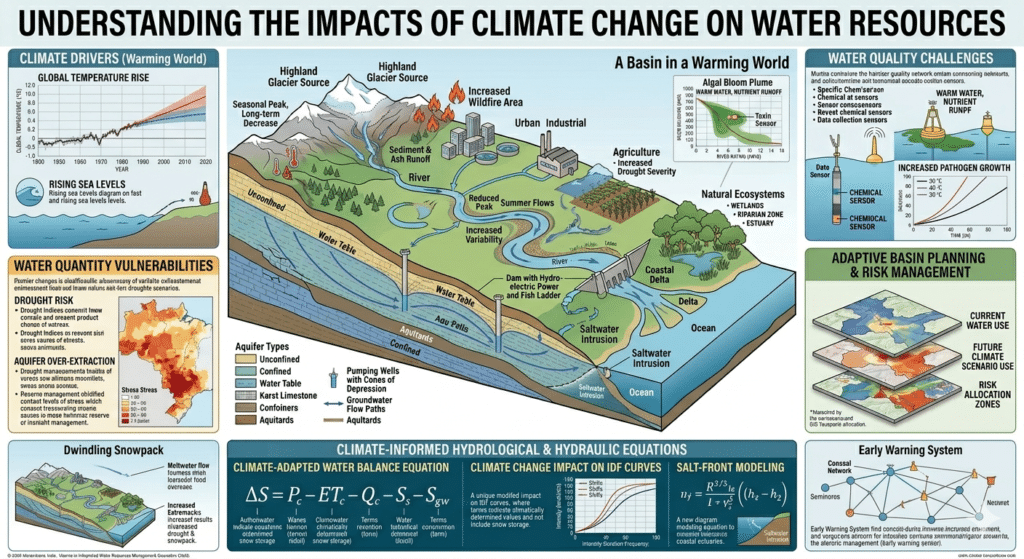
COURSE DESCRIPTION
This doctoral-level course provides a comprehensive and critical examination of the complex interactions between climate change and water resources. Students will explore the observed and projected impacts of climate variability on the hydrological cycle, water availability, quality, and extremes; the tools and methods for assessing climate change impacts on water systems; the principles of climate adaptation in the water sector; and the integration of climate resilience into water resources planning, policy, and management. Key topics include the global water cycle, downscaling techniques, hydrological modeling under uncertainty, vulnerability assessment, and case studies in adaptive water management. The course emphasizes the application of scientific knowledge, models, and governance frameworks to address the water-related risks and opportunities of a changing climate.
COURSE TEACHING OBJECTIVES
1. Analyze the observed and projected impacts of climate change on the hydrological cycle and water resources at global, regional, and basin scales.
2. Evaluate the methods and tools used for climate impact assessment, including downscaling, hydrological modeling, and uncertainty analysis.
3. Assess the vulnerability of water supply, demand, and quality to climate change and the risks to human and natural systems.
4. Critically examine adaptation strategies and governance frameworks for building climate resilience in the water sector.
5. Integrate climate adaptation principles into water resources planning, infrastructure design, and policy formulation.
COURSE STUDENT LEARNING OUTCOMES
Upon successful completion of this course, students will be able to:
1. Explain the key mechanisms through which climate change alters the hydrological cycle and water availability.
2. Apply climate data and modeling approaches to assess water-related climate impacts for a specific region or sector.
3. Conduct a climate vulnerability assessment for a water system and identify priority risks.
4. Propose and critically evaluate adaptation measures for water supply, flood management, and ecosystem protection.
5. Develop an integrated climate-resilient water management plan for a selected basin or community.
Organization of Course Studies
The course is organized into five study periods (typically 2 weeks each, though self-paced). Each period includes intensive reading of the assigned textbook, viewing of the supplementary video, and a short response paper or ethical analysis (500–1,000 words) reflecting on the material and its application.