

COURSE DESCRIPTION
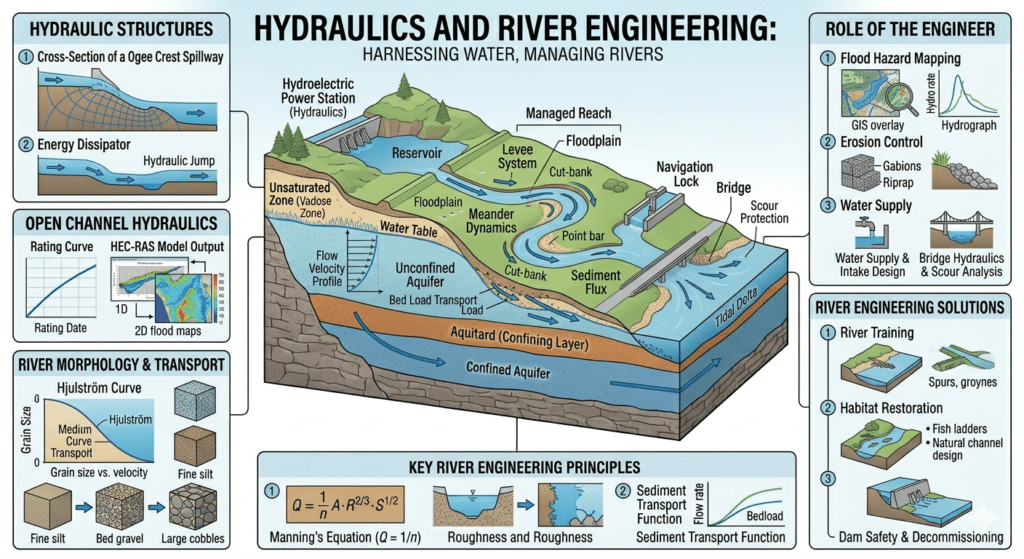
This doctoral-level course provides a comprehensive introduction to the principles of hydraulics and their application to river engineering. Students will explore the fundamental mechanics of fluid flow in open channels, the design of hydraulic structures, sediment transport processes, and the management of river systems. Key topics include open channel flow (steady and unsteady, uniform and non-uniform), hydraulic structures (weirs, sluice gates, spillways, stilling basins), sediment transport, river morphology, flood routing, and river restoration. The course integrates theoretical foundations with practical design and management applications, emphasizing the role of hydraulics in addressing contemporary challenges such as flood risk management, sustainable river engineering, and environmental protection.
COURSE TEACHING OBJECTIVES
- Analyze the fundamental principles of open channel hydraulics, including steady and unsteady, uniform and non-uniform flow.
- Apply energy and momentum principles to solve hydraulic problems and design hydraulic structures.
- Evaluate sediment transport processes and their influence on river morphology and engineering design.
- Assess the design and performance of river engineering structures (weirs, culverts, spillways, stilling basins) and their environmental implications.
- Critically examine approaches to flood routing, river restoration, and the integration of hydraulic engineering with sustainable river management.
COURSE STUDENT LEARNING OUTCOMES
Upon successful completion of this course, students will be able to:
- Classify open channel flow regimes (subcritical, critical, supercritical) and compute flow profiles.
- Design hydraulic structures (weirs, sluice gates, culverts, stilling basins) using energy and momentum principles.
- Analyze sediment transport rates and predict river bed changes (degradation, aggradation).
- Apply flood routing methods to predict flood wave propagation along rivers.
- Critically evaluate the environmental and ecological implications of river engineering interventions and propose sustainable alternatives.
Organization of Course Studies
The course is organized into five study periods (typically 2 weeks each, though self-paced). Each period includes intensive reading of the assigned textbook, viewing of the supplementary video, and a short response paper or ethical analysis (500–1,000 words) reflecting on the material and its application.