

COURSE DESCRIPTION
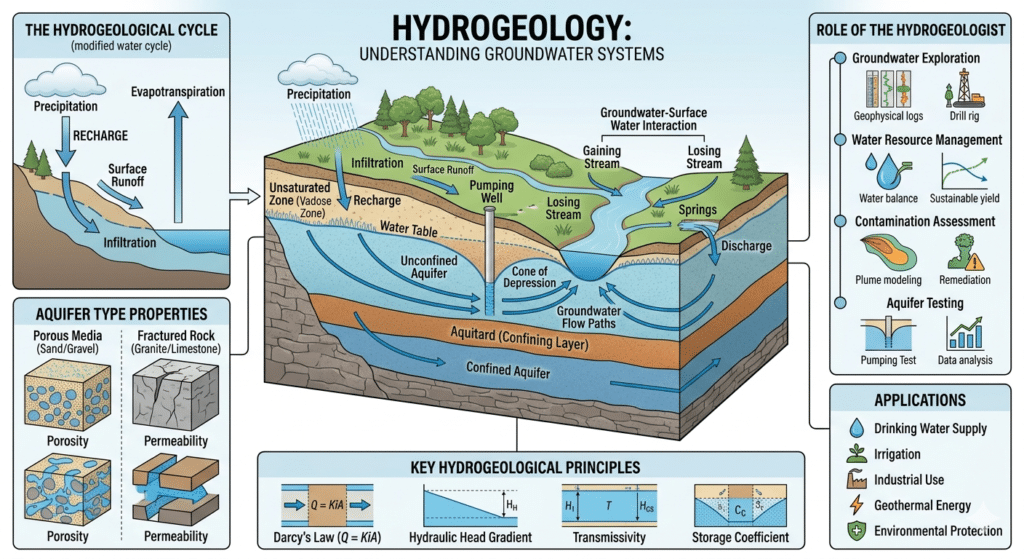
This doctoral-level course provides a comprehensive introduction to the principles of hydrogeology, focusing on the occurrence, movement, and quality of groundwater. Students will explore the physical and chemical properties of aquifers, the mechanics of groundwater flow, the interaction between groundwater and surface water, and the methods used to investigate and manage groundwater resources. Key topics include the hydrologic cycle, aquifer properties, Darcy’s law, flow nets, well hydraulics, groundwater chemistry, contaminant transport, and groundwater resource evaluation. The course integrates theoretical foundations with practical applications, case studies, and quantitative problem-solving, emphasizing the role of hydrogeology in water supply, environmental protection, and sustainable resource management.
COURSE TEACHING OBJECTIVES
- Analyze the occurrence and distribution of groundwater within the hydrologic cycle and its interaction with surface water.
- Evaluate the physical and hydraulic properties of aquifers and their influence on groundwater flow and storage.
- Apply Darcy’s law and flow net analysis to quantify groundwater flow rates and directions in various hydrogeologic settings.
- Assess well hydraulics, including steady-state and transient flow conditions, and interpret pumping test data to estimate aquifer parameters.
- Critically examine groundwater chemistry, contaminant transport processes, and the methods used to investigate, monitor, and remediate groundwater pollution.
COURSE STUDENT LEARNING OUTCOMES
Upon successful completion of this course, students will be able to:
- Describe the key components of the hydrologic cycle and explain the role of groundwater in global water resources.
- Calculate aquifer properties such as porosity, hydraulic conductivity, transmissivity, and storage coefficient.
- Construct and interpret flow nets to analyze groundwater flow patterns and quantities.
- Analyze pumping test data using steady-state and transient well hydraulics equations to estimate aquifer parameters.
- Identify sources of groundwater contamination and evaluate the processes that control contaminant transport, fate, and remediation.
Organization of Course Studies
The course is organized into five study periods (typically 2 weeks each, though self-paced). Each period includes intensive reading of the assigned textbook, viewing of the supplementary video, and a short response paper or ethical analysis (500–1,000 words) reflecting on the material and its application.