COURSE DESCRIPTION
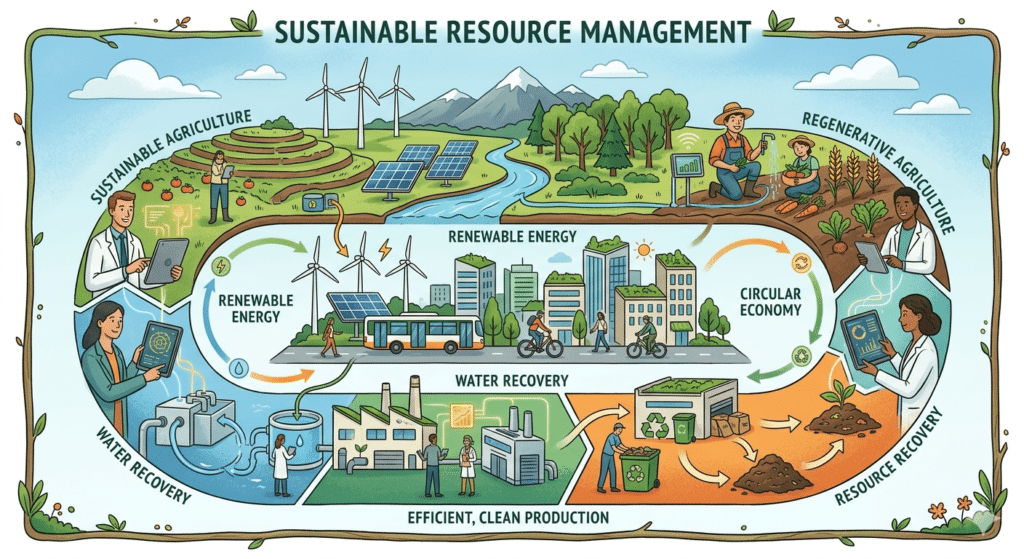
This doctoral-level course provides a comprehensive introduction to the principles and practices of sustainable resource management. Students will examine the ecological, economic, social, and political dimensions of managing natural resources for current and future generations. Key topics include the concept of sustainability and resource scarcity; resource economics and natural capital; renewable and non-renewable resource management (water, land, forests, fisheries, minerals, energy); circular economy principles and waste management; life-cycle assessment and resource efficiency; ecosystem services valuation; and policy instruments for sustainable resource governance. The course integrates theory with case studies and emphasizes the role of technology, innovation, and behavioral change in transitioning toward a circular and regenerative economy.
COURSE TEACHING OBJECTIVES
- Analyze the concept of sustainable resource management and its evolution from conservation to circular economy.
- Apply economic principles (e.g., valuation, discounting, market failures) to natural resource decision-making.
- Evaluate management strategies for renewable resources (water, forests, fisheries) and non-renewable resources (minerals, fossil fuels).
- Assess the principles of the circular economy (reduce, reuse, recycle, recover) and their application to waste management and product design.
- Critically examine policy instruments (regulations, economic incentives, voluntary agreements) and governance frameworks for sustainable resource management at local, national, and global scales.
COURSE STUDENT LEARNING OUTCOMES
Upon successful completion of this course, students will be able to:
- Explain the concept of sustainable resource management and its relevance to global challenges such as climate change, biodiversity loss, and resource depletion.
- Apply economic valuation methods to assess the costs and benefits of resource use and conservation.
- Design a management plan for a specific renewable or non-renewable resource, considering ecological limits, economic efficiency, and social equity.
- Identify opportunities for circular economy strategies in product design, production, and consumption systems.
- Evaluate the effectiveness of policy instruments in promoting sustainable resource management and propose recommendations for improvement.
Organization of Course Studies
The course is organized into five study periods (typically 2 weeks each, though self-paced). Each period includes intensive reading of the assigned textbook, viewing of the supplementary video, and a short response paper or ethical analysis (500–1,000 words) reflecting on the material and its application.