

COURSE DESCRIPTION
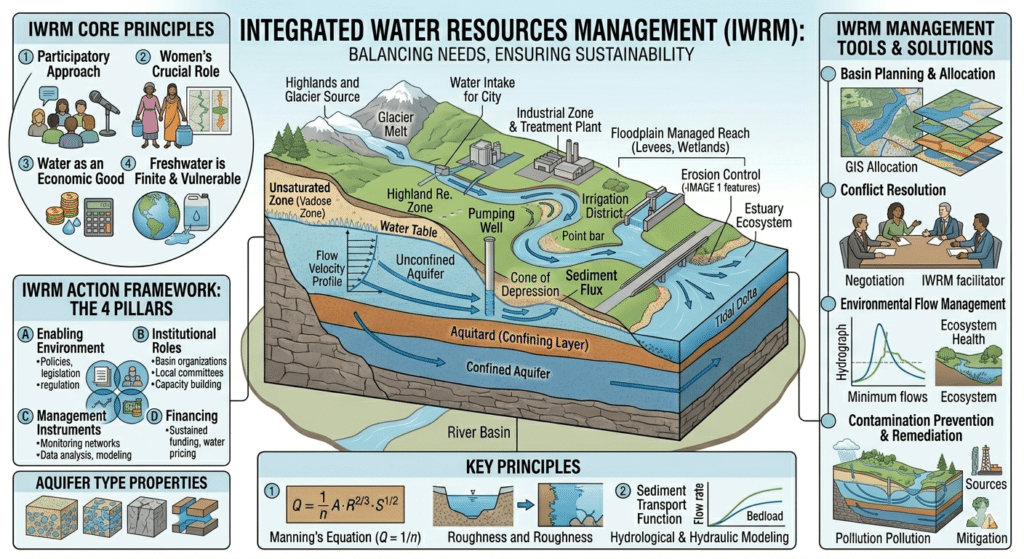
This doctoral-level course provides a comprehensive and critical examination of the principles, frameworks, and implementation of Integrated Water Resources Management (IWRM). Students will explore the evolution of IWRM as a global water management paradigm, its foundational principles, and its application across various hydrological, institutional, and socio-economic contexts. Key topics include the Dublin Principles and enabling environment; water governance, law, and policy; economic and financial instruments; stakeholder participation and conflict resolution; the water-food-energy-ecosystems nexus; climate change adaptation; and critical perspectives on IWRM implementation challenges. The course emphasizes the integration of natural and social sciences to address complex water challenges and prepares students to lead and evaluate IWRM initiatives at local, basin, national, and transboundary scales.
COURSE TEACHING OBJECTIVES
- Critically analyze the historical evolution, conceptual foundations, and key principles of Integrated Water Resources Management (IWRM).
- Evaluate the role of enabling environments, including legal frameworks, policies, and institutions, in IWRM implementation.
- Assess economic and financial instruments for water allocation, demand management, and sustainable financing.
- Examine participatory governance, stakeholder engagement, and conflict resolution mechanisms in water management.
- Critically appraise the application of IWRM to transboundary waters, the water-energy-food-ecosystems nexus, and climate adaptation, while analyzing implementation challenges and reform trajectories.
COURSE STUDENT LEARNING OUTCOMES
Upon successful completion of this course, students will be able to:
- Explain the core principles and components of IWRM and distinguish it from conventional sectoral water management approaches.
- Assess the strengths and weaknesses of existing legal, policy, and institutional frameworks for IWRM in a given context.
- Propose appropriate economic instruments to improve water use efficiency, equity, and sustainability.
- Design a stakeholder engagement and participatory planning process for a water management challenge.
- Develop an IWRM implementation plan for a specific basin or region, integrating climate adaptation, nexus thinking, and lessons from case studies.
Organization of Course Studies
The course is organized into five study periods (typically 2 weeks each, though self-paced). Each period includes intensive reading of the assigned textbook, viewing of the supplementary video, and a short response paper or ethical analysis (500–1,000 words) reflecting on the material and its application.