
COURSE DESCRIPTION
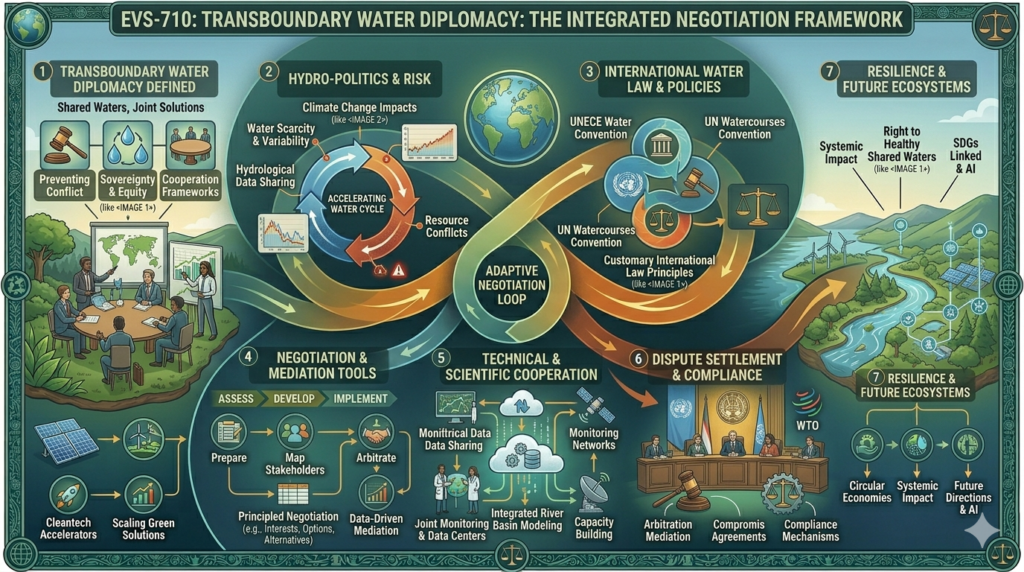
This doctoral-level course provides a comprehensive and critical examination of the principles, practices, and governance of transboundary water diplomacy. Students will explore the legal, political, economic, and environmental dimensions of managing shared freshwater resources—rivers, lakes, and aquifers—that cross international borders. Key topics include the foundations of water diplomacy and its distinction from other forms of diplomacy; the international legal framework governing transboundary waters (UN Watercourses Convention, customary law, and basin-specific treaties); negotiation and conflict resolution theories applied to water disputes; benefit-sharing and cooperative mechanisms; the role of international organizations and river basin organizations; the impacts of climate change on transboundary water governance; and emerging challenges such as data diplomacy, hydropolitics, and the water-energy-food nexus. The course emphasizes the integration of science, policy, and diplomacy to build resilient and equitable transboundary water agreements.
COURSE TEACHING OBJECTIVES
- Critically analyze the key concepts, frameworks, and historical evolution of transboundary water diplomacy.
- Evaluate the international legal principles and treaty regimes governing shared freshwater resources, including the UN Watercourses Convention and regional agreements.
- Apply negotiation, mediation, and conflict resolution theories to transboundary water disputes and cooperative management.
- Assess the role of multilateral institutions, river basin organizations, and stakeholder engagement in water diplomacy.
- Examine the impacts of climate change, population growth, and geopolitical shifts on transboundary water governance and propose adaptive diplomatic responses.
COURSE STUDENT LEARNING OUTCOMES
Upon successful completion of this course, students will be able to:
- Explain the core principles and frameworks of transboundary water diplomacy and distinguish it from other forms of diplomacy.
- Interpret and apply international water law principles to analyze transboundary water agreements and disputes.
- Design and critique negotiation strategies for transboundary water conflicts, incorporating mutual gains and benefit-sharing approaches.
- Analyze the roles and effectiveness of river basin organizations and other institutional mechanisms in facilitating cooperation.
- Develop an adaptive water diplomacy strategy for a specific transboundary basin that addresses climate and geopolitical uncertainties.
Organization of Course Studies
The course is organized into five study periods (typically 2 weeks each, though self-paced). Each period includes intensive reading of the assigned textbook, viewing of the supplementary video, and a short response paper or ethical analysis (500–1,000 words) reflecting on the material and its application.
The first part of the course will be completed at Coursera through the following link: https://www.coursera.org/learn/water-cooperation-and-diplomacy
Once done, submit your certificate along with your scores. The last step will be choosing a suitable MP title and writing your MP.