
COURSE DESCRIPTION
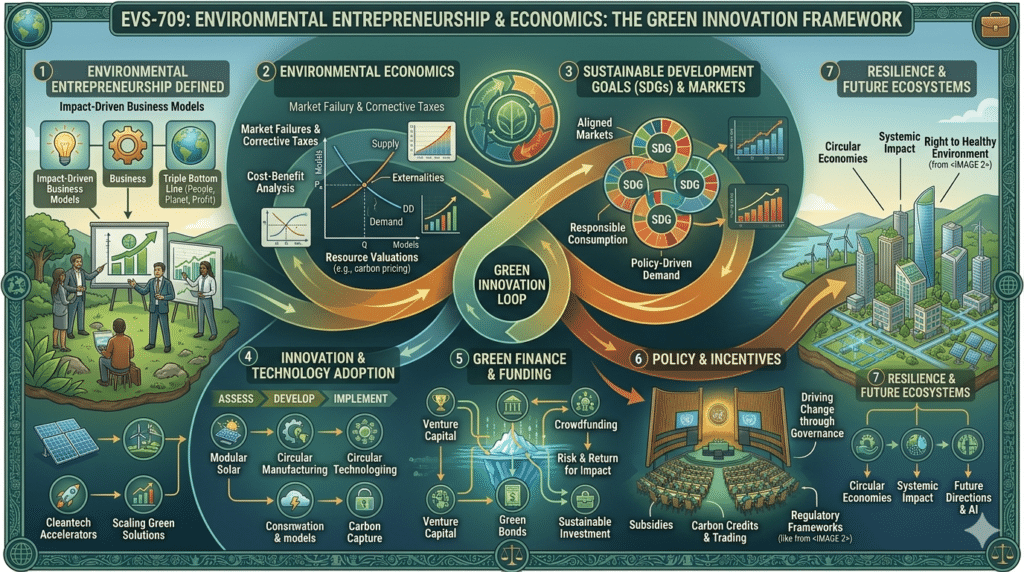
This doctoral-level course examines the dynamic intersection of entrepreneurship, economics, and environmental sustainability. Students will explore the theoretical and practical dimensions of environmental and social entrepreneurship (ecopreneurship), the economic principles underlying environmental challenges, and the design of sustainable business models and financial mechanisms that drive the green transition. Key topics include the fundamentals of environmental economics (externalities, public goods, valuation); the ecopreneurial process from opportunity recognition to scaling; circular economy business models; green finance, impact investing, and ESG frameworks; and the role of innovation, policy, and systems thinking in fostering sustainable economic development. The course emphasizes the critical analysis of market-based environmental solutions, the economic viability of sustainable ventures, and the potential for entrepreneurship to address pressing environmental crises.
COURSE TEACHING OBJECTIVES
- Critically analyze the core concepts of environmental economics, including market failures, externalities, and valuation methods, and their implications for sustainable business.
- Evaluate the characteristics, motivations, and processes of environmental entrepreneurship (ecopreneurship) and its role in addressing environmental challenges.
- Assess the principles and practices of circular economy business models and their economic and environmental performance.
- Critically examine green finance mechanisms, impact investing strategies, and ESG (Environmental, Social, Governance) frameworks.
- Integrate economic analysis, entrepreneurial strategy, and systems thinking to design and evaluate sustainable business models for the green transition.
COURSE STUDENT LEARNING OUTCOMES
Upon successful completion of this course, students will be able to:
- Explain and apply key environmental economics concepts to diagnose market failures and assess policy interventions.
- Identify and evaluate opportunities for environmental entrepreneurship across different sectors.
- Design a circular business model and assess its viability using economic and sustainability metrics.
- Analyze the role of green finance and impact investing in scaling environmental ventures and propose appropriate financial strategies.
- Develop a comprehensive business plan or policy proposal for a sustainable venture, integrating economic, entrepreneurial, and systems perspectives.
Organization of Course Studies
The first part of the course will be completed at Coursera through the following link: https://www.coursera.org/learn/environmental-economics
Once done, submit your certificate along with your scores. The last step will be choosing a suitable MP title and writing your MP.