
COURSE DESCRIPTION
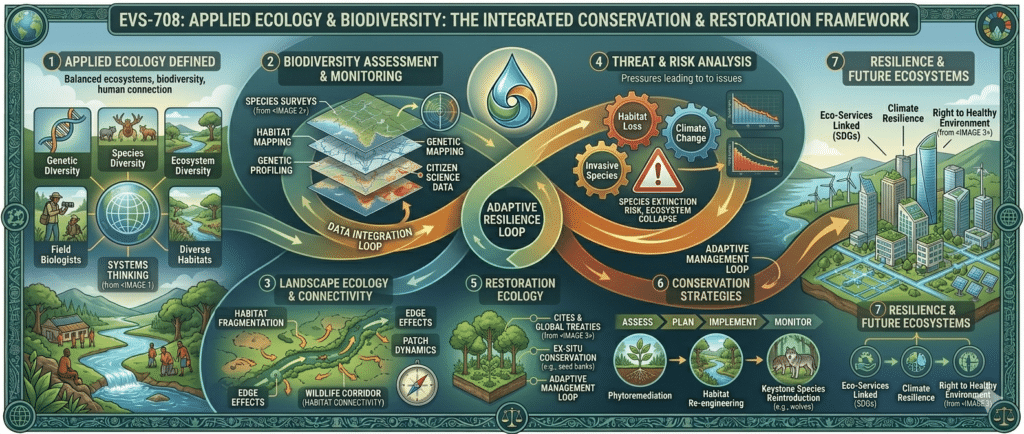
This doctoral-level course provides a comprehensive and critical examination of the principles and applications of applied ecology and biodiversity conservation. Students will explore the scientific foundations of ecology—from populations and communities to ecosystems and landscapes—and their application to real-world environmental challenges. Key topics include biodiversity measurement and distribution, conservation biology principles, population viability analysis, community dynamics, ecosystem services, restoration ecology, and the integration of ecological science into policy and management. The course emphasizes the translation of ecological theory into practical strategies for conserving biodiversity, managing natural resources, and addressing global change. Students will develop advanced skills in ecological analysis, conservation planning, and evidence-based decision-making.
COURSE TEACHING OBJECTIVES
- Analyze the foundational principles of applied ecology and their relevance to biodiversity conservation.
- Critically evaluate methods for measuring, monitoring, and modeling biodiversity across spatial and temporal scales.
- Apply population and community ecology concepts to the management of species and habitats.
- Assess the role of ecosystem services and restoration ecology in sustaining biodiversity and human well-being.
- Integrate ecological science with policy, governance, and social dimensions to address global biodiversity challenges.
COURSE STUDENT LEARNING OUTCOMES
Upon successful completion of this course, students will be able to:
- Design and critique biodiversity monitoring programs using appropriate ecological methods.
- Conduct population viability analyses and assess extinction risk for threatened species.
- Develop evidence-based conservation strategies that integrate ecological, social, and economic considerations.
- Evaluate restoration projects using ecological success criteria and adaptive management frameworks.
- Critically analyze global biodiversity policy instruments and their implementation at national and local levels.
Organization of Course Studies
The course is organized into five study periods (typically 2 weeks each, though self-paced). Each period includes intensive reading of the assigned textbook, viewing of the supplementary video, and a short response paper or ethical analysis (500–1,000 words) reflecting on the material and its application.