

COURSE DESCRIPTION
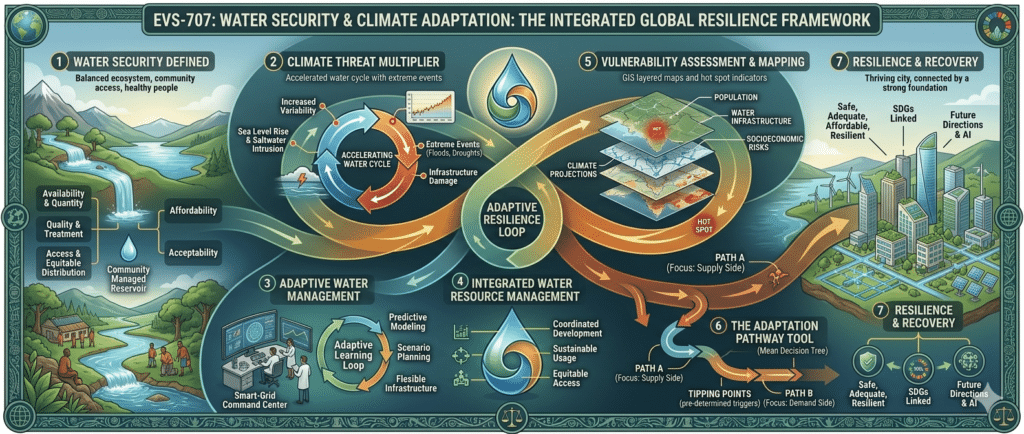
This doctoral-level course provides a comprehensive and interdisciplinary examination of the critical nexus between water security and climate adaptation. Students will explore the multifaceted dimensions of water security—including availability, access, use, and resilience—in the context of a changing climate. Key topics include the impacts of climate change on hydrological cycles; water scarcity, droughts, and floods; adaptation strategies in water supply, sanitation, agriculture, and energy; water governance and policy frameworks; transboundary water management; nature-based solutions and green infrastructure; and the integration of water security into climate policy (e.g., Nationally Determined Contributions). The course emphasizes the application of systems thinking, vulnerability assessments, and adaptive management to build climate-resilient water systems at local, national, and transboundary scales.
COURSE TEACHING OBJECTIVES
- Analyze the complex interactions between climate change and hydrological systems, and their implications for water security.
- Critically evaluate adaptation strategies and technologies for enhancing water security in different sectors (agriculture, urban water supply, energy, ecosystems).
- Assess water governance frameworks and policy instruments for climate-resilient water management.
- Design and apply vulnerability assessments and adaptation planning methodologies for water systems.
- Examine transboundary water management challenges and cooperation mechanisms in a changing climate.
COURSE STUDENT LEARNING OUTCOMES
Upon successful completion of this course, students will be able to:
- Explain the key pathways through which climate change affects water availability, quality, and extremes.
- Identify and critically assess adaptation options for water security across multiple sectors.
- Evaluate the strengths and weaknesses of different water governance and policy approaches for climate adaptation.
- Conduct a vulnerability assessment for a specific water system or region.
- Develop an integrated climate adaptation plan for water security that incorporates technical, social, and governance dimensions.
Organization of Course Studies
The course is organized into five study periods (typically 2 weeks each, though self-paced). Each period includes intensive reading of the assigned textbook, viewing of the supplementary video, and a short response paper or ethical analysis (500–1,000 words) reflecting on the material and its application.