
COURSE DESCRIPTION
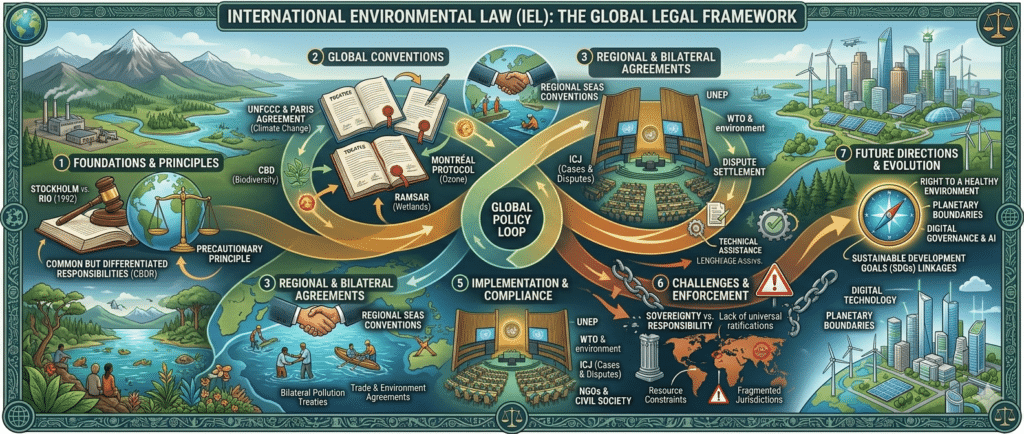
This doctoral-level course provides a comprehensive and critical examination of the principles, institutions, and treaty regimes that constitute international environmental law (IEL). Students will explore the historical development of IEL, its sources, key substantive and procedural principles, and the architecture of multilateral environmental agreements (MEAs). The course covers major treaty regimes addressing climate change, biodiversity loss, transboundary pollution, and the protection of the oceans and atmosphere. Emphasis is placed on the intersection of environmental law with human rights, international trade, and investment law, as well as emerging issues such as the rights of nature, environmental migration, and climate litigation. Students will develop the capacity to critically analyze legal instruments, assess their effectiveness, and evaluate their implications for environmental governance at the international level.
COURSE TEACHING OBJECTIVES
- Analyze the historical evolution, sources, and institutional framework of international environmental law.
- Critically evaluate the core principles of IEL, including sustainable development, precaution, common but differentiated responsibilities, and the polluter-pays principle.
- Assess the architecture, implementation, and effectiveness of major multilateral environmental agreements (MEAs) across different issue areas.
- Evaluate the interaction between international environmental law and other legal regimes (e.g., human rights law, WTO law, investment law).
- Critically examine emerging challenges and trends in IEL, including climate litigation, environmental migration, and the rights of nature.
COURSE STUDENT LEARNING OUTCOMES
Upon successful completion of this course, students will be able to:
- Identify and explain the sources, subjects, and institutions of international environmental law.
- Apply core principles of international environmental law to analyze environmental problems and policy options.
- Compare and contrast the legal frameworks governing climate change, biodiversity, and transboundary pollution.
- Analyze compliance, implementation, and dispute resolution mechanisms in multilateral environmental agreements.
- Critically evaluate emerging legal issues and propose legal and policy responses to new environmental challenges.
Organization of Course Studies
The course is organized into five study periods (typically 2 weeks each, though self-paced). Each period includes intensive reading of the assigned textbook, viewing of the supplementary video, and a short response paper or ethical analysis (500–1,000 words) reflecting on the material and its application.