
COURSE DESCRIPTION
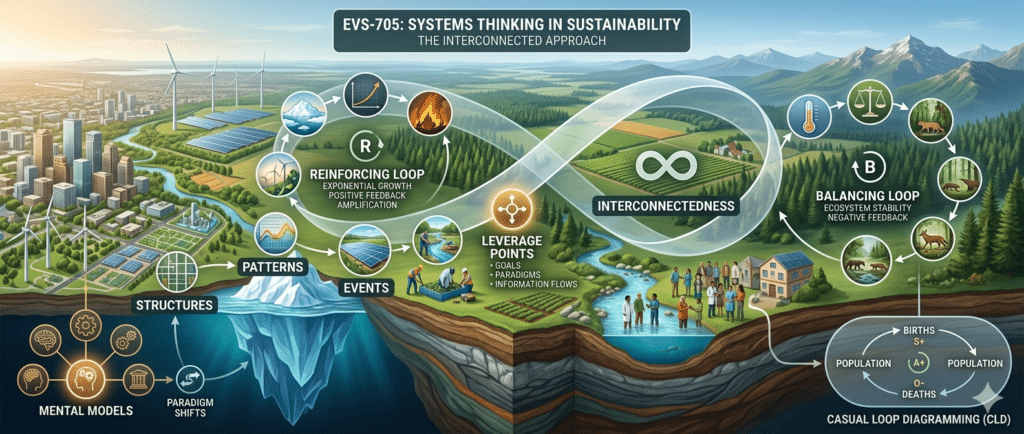
This doctoral-level course provides a comprehensive introduction to the principles and applications of systems thinking for sustainability. Students will explore the fundamental concepts of systems theory, including feedback loops, stocks and flows, and causal loop diagrams, and apply them to understand and address complex socio-ecological challenges. Key topics include the nature of wicked problems, system dynamics modeling, resilience and adaptive capacity, leverage points for system change, and the application of systems thinking to climate change, biodiversity loss, resource management, and sustainable development. The course emphasizes the development of practical skills in systems mapping, analysis, and intervention design, and prepares students to integrate systems perspectives into research, policy, and practice.
COURSE TEACHING OBJECTIVES
- Analyze the foundational concepts and principles of systems thinking, including feedback, stocks and flows, and causal loop diagrams.
- Apply systems thinking tools and methods to diagnose and understand complex sustainability challenges.
- Evaluate the role of system dynamics modeling in predicting and managing the behavior of complex systems.
- Critically examine the concepts of resilience, adaptation, and transformation in socio-ecological systems.
- Design interventions and leverage points for system change towards sustainability, considering ethical and equity implications.
COURSE STUDENT LEARNING OUTCOMES
Upon successful completion of this course, students will be able to:
- Define and apply core systems thinking concepts to real-world sustainability problems.
- Construct and interpret causal loop diagrams and stock-and-flow diagrams.
- Analyze the behavior of a system using system dynamics modeling software.
- Identify and evaluate leverage points for system change in a given context.
- Develop a systems-informed research or policy proposal to address a sustainability challenge.
Organization of Course Studies
The course is organized into five study periods (typically 2 weeks each, though self-paced). Each period includes intensive reading of the assigned textbook, viewing of the supplementary video, and a short response paper or ethical analysis (500–1,000 words) reflecting on the material and its application.