

COURSE DESCRIPTION
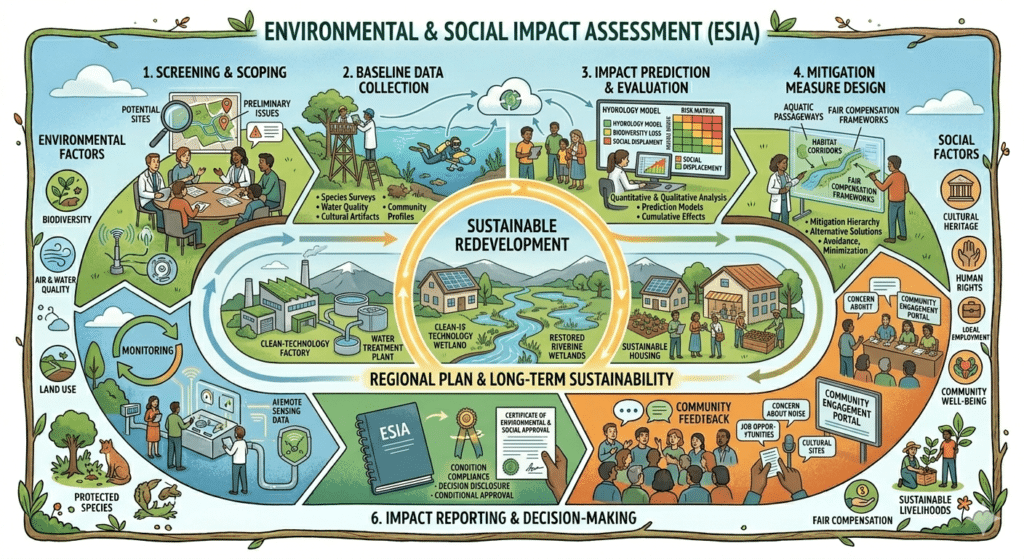
This doctoral-level course provides a comprehensive and critical introduction to the theory, practice, and governance of Environmental and Social Impact Assessment (ESIA). Students will examine the ESIA process from screening and scoping through impact prediction, mitigation, management, and follow-up, with a particular focus on the integration of social considerations. Key topics include the legal and policy frameworks for ESIA; the procedural steps (screening, scoping, baseline studies, impact prediction, mitigation, and monitoring); social impact assessment (SIA) methods; public participation and stakeholder engagement; comparative analysis of ESIA systems; and emerging trends, including strategic environmental assessment (SEA) and the application of digital tools. The course emphasizes the application of ESIA as a tool for sustainable development, balancing environmental protection, social equity, and economic development.
COURSE TEACHING OBJECTIVES
- Analyze the history, purpose, legal foundations, and international frameworks of ESIA.
- Apply the key procedural steps of the ESIA process, including screening, scoping, baseline studies, impact prediction, and mitigation.
- Critically evaluate social impact assessment (SIA) methodologies and their integration into the ESIA process.
- Design and critique public participation and stakeholder engagement strategies for ESIA.
- Assess the role of follow-up, monitoring, auditing, and adaptive management in ESIA effectiveness.
- Compare ESIA systems across different jurisdictions and analyze emerging trends such as strategic environmental assessment (SEA).
COURSE STUDENT LEARNING OUTCOMES
Upon successful completion of this course, students will be able to:
- Critically explain the ESIA process and its role in sustainable development.
- Design a screening and scoping plan for a proposed project or development.
- Identify, predict, and evaluate potential environmental and social impacts using appropriate methods.
- Develop a mitigation and environmental management plan (EMP).
- Formulate a public participation and stakeholder engagement strategy.
- Critically assess an ESIA report and propose improvements.
Organization of Course Studies
The course is organized into five study periods (typically 2 weeks each, though self-paced). Each period includes intensive reading of the assigned textbook, viewing of the supplementary video, and a short response paper or ethical analysis (500–1,000 words) reflecting on the material and its application.